






We live in a world where crises are converging. Climate change, forced migration, conflict and economic shocks, to name but a few. In this context, strengthening education system resilience – the capacity to not only withstand shocks but adapt and evolve – is critical. Through the Observatory on Education System Resilience initiative, implemented under the Global Partnership for Education Knowledge and Innovation Exchange (GPE KIX), six regional observatories are helping to understand what education system resilience means across countries.
The Observatory in Eastern Europe, Caucasus and Central Asia (EECCA) has recently completed primary data collection through interviews with key informants in eight countries. While waiting for the full findings to be published later this year, we interview some of the researchers who have spoken to ministries of education, civil society organizations, international development agencies and more.
In a three-part blog series, we explore how education system resilience is understood and practised in different countries, what has changed because of past crises, and what needs to happen to prepare for future disruptions. In this second blog post, we speak with Aigoul Abdoubaetova, an education researcher in Kyrgyzstan.
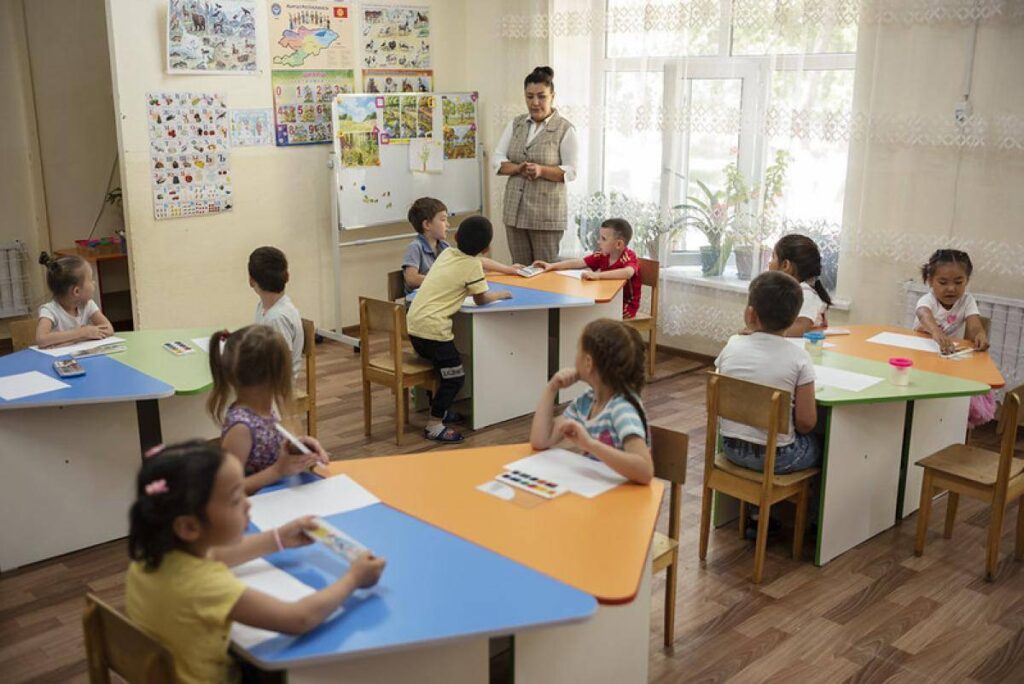
Credit: GPE/Maxime Fossat
Q.: What is the general perception people have of education system resilience? Is this a widely understood term and do most people understand it in similar ways?
I interviewed six stakeholders from government, international development organizations, academia and the education sector.Overall, as interviews showed, the term “education system resilience” is not widely used at the moment.
Most respondents indicated that the concept appears in normative and strategic documents. However, they rarely elaborated on specific resilience-related policies, nor did they demonstrate a strong interest in explaining their understanding of the term.
Some argued that many good ideas look fine on paper but fall short in practice. Policies have limited value if they are not implemented because of insufficient funding and institutional capacity. In this view, resilience depends not only on the availability of resources but also on the system’s ability and readiness to plan, coordinate and implement policies effectively.
Interpretations of the concept varied according to respondents’ professional backgrounds. Representatives of international development organizations and academia understood education system resilience as the ability of the education system to withstand, adapt to and recover from shocks while continuing to provide education.
In contrast, some government and school representatives associated the term with continuous education, life-long learning and sustainable development. This may partly reflect translation issues, as the local language equivalent of “resilience” can also be interpreted as “sustainability”.
The interviews therefore suggest that education system resilience remains a relatively unfamiliar concept within local education policy discourse, indicating somewhat a mismatch between international development terminology and local policy frameworks.
At the same time, respondents were able to discuss resilience clearly when referring to concrete practices rather than abstract terminology. Although the term itself is not widely used, many informants described resilience-related measures when they discussed school infrastructure, digitalization, teacher availability and other practical issues.
Many adaptive practices emerged as reactive responses, particularly during the COVID-19 pandemic, but subsequently evolved into longer-term changes. For example, video lessons and digital learning resources were developed with strong support from civil society, including well-known educational experts, academics and practitioners who volunteered their skills and knowledge to organize distance learning classes.
International development organizations provided financial assistance, supported curriculum development and supplied computers to teachers. More recently, the government has increased its focus on school construction, teacher salaries and the development of digital platforms. These digital platforms are designed to support online learning, student assessment, school and teacher management, and data collection.
All these examples suggest that resilience in Kyrgyzstan is often practised without being explicitly labeled as such. It is produced not only by government institutions but also through cooperation with civil society organizations, international partners and teachers, who were frequently described as some of the most resilient actors within the system.
Nevertheless, frequent leadership changes, limited analytical capacity and a predominantly top-down approach to reform continue to constrain effective policy implementation. Overall, education system resilience appears to be more visible as a collection of adaptive practices than a clearly defined and widely understood policy concept.
Q.: Have the informants identified any disruptions to education systems that have informed new policies and practices, making the systems stronger and more resilient?
The COVID-19 pandemic was identified as Kyrgyzstan’s most significant educational crisis in recent history. It was described as an unprecedented turning point, not only because it disrupted the system but also because it led to longer-lasting changes, particularly the regular use of online education as an alternative solution during disruptions.
Beyond the COVID-19 pandemic, the three education disruptions most frequently mentioned were the Kyrgyz-Tajik border conflict, which interrupted schooling in affected villages; planned disruptions associated with hosting major international summits and events, primarily affecting the country’s capital, Bishkek (i.e., classes can be postponed because some roads and facilities need to be closed for security reasons); and temporary school closures resulting from school construction and renovation projects.
These disruptions were generally localized, short-term and operational in nature. In most cases, online schooling has been used as a viable alternative.
Respondents noted that the pandemic experience significantly improved the digital skills of both teachers and students. Today, teachers still use the video lessons, lectures and digital learning resources developed during that period. Based on this experience, it can be argued that the education system has strengthened its capacity to respond to short-term disruptions.
Online education is now regularly employed to address various interruptions to schooling. School administrators consider online education an effective way to avoid disruptions without extending the school calendar or scheduling additional lessons.
However, significant challenges remain in ensuring both quality and accessibility of online education. Access to computers, internet connectivity and basic digital skills continue to be uneven. Rural communities and large, low-income families with multiple school-age children remain particularly vulnerable. While many children have access to mobile phones, households are not necessarily equipped with computers or laptops. During online learning, families with several children often struggle because each child needs a separate device.
Another major challenge is that working parents often cannot stay at home when classes move online. Younger children, especially those in primary school, frequently need adult supervision and support to participate effectively in online learning. Children with disabilities, particularly those with developmental or cognitive impairments, continue to face substantial barriers — regardless of the mode of instruction.
Thus, while the COVID-19 pandemic has increased the adaptability of the education system, it has also exposed long-standing inequalities that remain insufficiently addressed.
Q.: What are the most anticipated future disruptions to education and how is the country preparing for them?
Respondents were generally more interested in discussing current systemic challenges than hypothetical future disruptions. These challenges included teacher shortages, a lack of textbooks, low salaries, overcrowded schools, inadequate educational infrastructure and a perceived decline in the quality of education.
In addition, Kyrgyzstan’s education system is currently undergoing one of the most significant reforms in its history: The shift from an 11-year to a 12-year schooling system to align with international practice and modernize the curriculum.
Given the scale and immediacy of these issues, they tend to take precedence over anticipatory planning for future crises.
In this context, education system resilience in Kyrgyzstan is understood less as preparation for potential future shocks and more as the ability to cope with ongoing structural challenges. Anticipatory thinking therefore appears to remain relatively underdeveloped.
At the same time, respondents emphasized that many of the challenges currently facing the education system could evolve into larger future crises if left unresolved. Continued demographic growth in urban areas, for example, is placing increasing pressure on school infrastructure. In response, the government has begun constructing new schools and encouraging the expansion of private schools. Nevertheless, the demand for additional schools and qualified teachers remains one of the country’s most significant educational challenges, particularly in rapidly growing urban areas.
Although climate-related risks were generally not viewed as an immediate threat to educational resilience, several respondents highlighted worsening air quality and the lack of air conditioning in many public schools as concerns for children’s health and learning conditions. More broadly, awareness of the potential long-term consequences of climate-related disruptions appears relatively limited.
Respondents identified earthquakes, floods and air pollution as possible future threats but noted that Kyrgyzstan is not typically exposed to natural hazards severe enough to disrupt schooling on a large scale. Schools generally remain open during periods of heavy snowfall or extreme heat.
Some interviewees also observed that schools have operated for decades despite lacking access to water, canteens, indoor sanitation facilities and other basic infrastructure. Paradoxically, this has contributed to the perception that schools have become resilient to hardships.
Respondents additionally identified rapid technological change, including the growing use of artificial intelligence, as a potential future challenge. Teachers often struggle to keep pace with developments in AI. Energy and electricity shortages were also mentioned as factors that could generate future educational disruptions.
More broadly, many respondents found it difficult to identify future shocks beyond demographic pressures, technological change and a limited range of environmental risks. This further suggests that anticipatory planning remains relatively underdeveloped.
Reflecting on both current and anticipated challenges, as well as lessons learned from the COVID-19 pandemic, one recurring pattern emerged: Crises tend to expose and deepen existing inequalities within the education system. Across interviews, students attending overcrowded public schools, children living in rural areas, those from large and low-income families, children left behind by migrant parents, children with disabilities and children from linguistic minority groups were consistently identified as the populations most vulnerable to education disruptions.
In conclusion, the interviews suggest that resilience in Kyrgyzstan is often practised without being explicitly recognized or labeled as such. This highlights the importance of research that examines local practices and understandings alongside international concepts and terminology. They also show that resilience building has largely emerged through practical responses to crises and collaboration among government, schools, civil society and international partners — even though the concept itself remains unfamiliar to many stakeholders.
The Kyrgyz case further demonstrates that crises can act as catalysts for adaptation and innovation. The COVID-19 pandemic accelerated the development of digital learning resources, strengthened teachers’ digital skills and normalized the use of online learning during disruptions. At the same time, it exposed persistent inequalities in access to technology, resources and support, underscoring the need to address structural barriers that limit some groups’ participation in education during times of crisis.
More broadly, the findings show that resilience depends not only on preparedness for future shocks but also on the ability to address underlying systemic challenges, including teacher shortages, overcrowded schools and inadequate infrastructure. For policymakers, this points to the need to move beyond reactive crisis management toward a more proactive approach to resilience planning.
This includes strengthening institutional capacity, embedding resilience into policy and planning processes, improving coordination across stakeholders and prioritizing the needs of learners who are most vulnerable to disruption. Without addressing these underlying vulnerabilities, future crises are likely to deepen existing educational inequalities rather than reduce them.
The views expressed by the interviewees and researcher do not necessarily represent those of GPE or its partners.
The full regional findings of the Observatory in Eastern Europe, Caucasus and Central Asia (EECCA) will be published in a report later in 2026. Explore other blog posts in this series on Ukraine and Uzbekistan.
This blog was first published on the GPE KIX website.
Support Cedos
During the war in Ukraine, we collect and analyse data on its impact on Ukrainian society, especially housing, education, social protection, and migration

 Support


